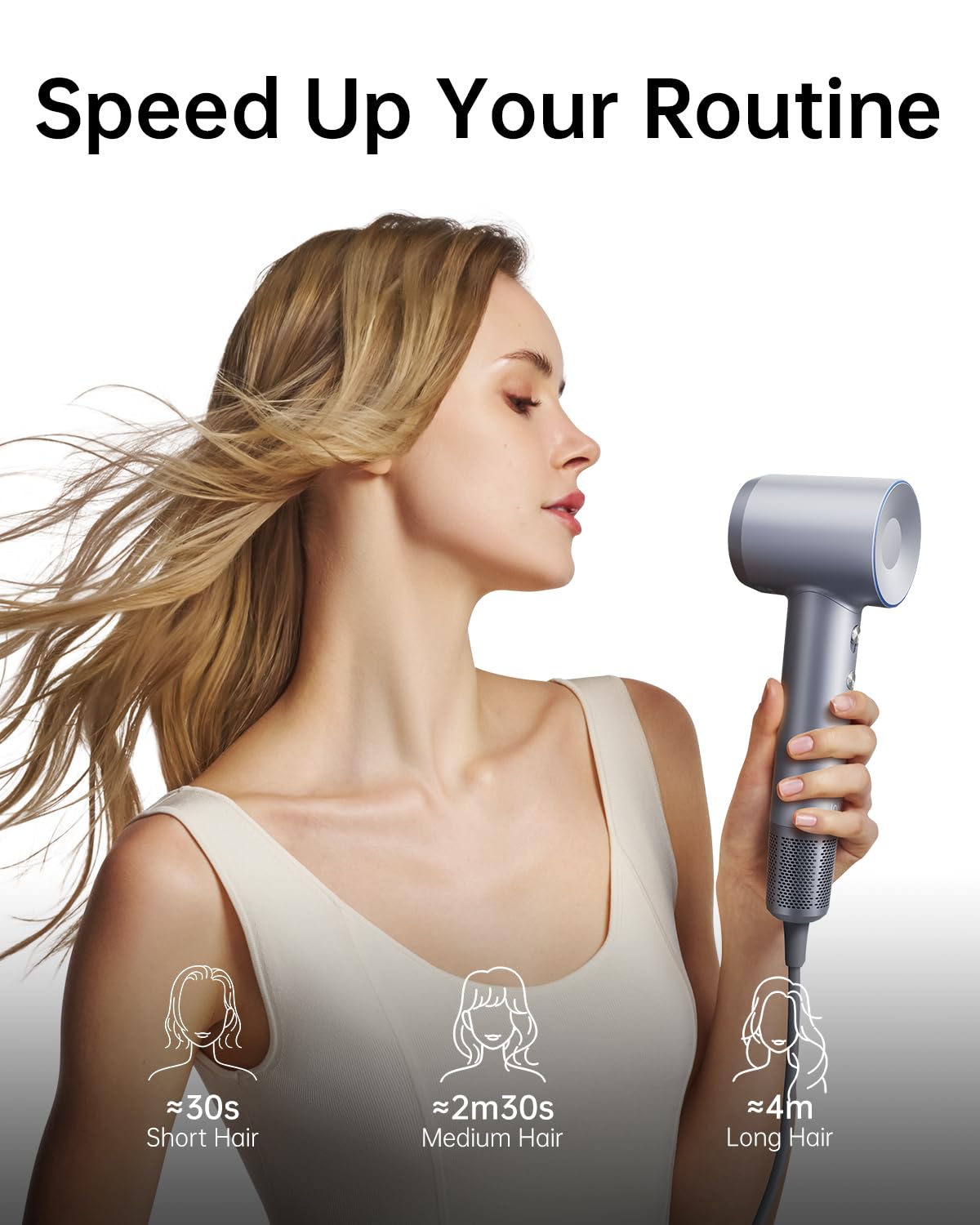
If you’re new to hearing the phrase “brushless motor,” here’s the quick version: a traditional hair dryer uses a motor with small carbon brushes that create friction to generate electrical current. A brushless motor (the same technology in cordless power tools and high-end electric vehicles) eliminates those physical contact points, which means less heat generated by the motor itself, a longer lifespan, and — the part that matters most to working stylists — significantly more airflow relative to the dryer’s weight. The “high-speed” descriptor refers to the motor’s RPM rating, which correlates directly to how fast and powerfully air is pushed through the barrel. When these two features combine, you get a dryer that dries hair faster, runs cooler to the touch, and typically lasts longer than a conventional salon dryer at the same price point. If you’re doing 40 blowouts a week, that’s not a feature list — that’s an ROI calculation.
| EDITOR'S PICK[Dyson Supersonic™ Origin Hair D…](https://www.amazon.com/dp/B0F5DMBGT6?tag=greenflower20-20) | Mid-tier[BaBylissPRO Hair Dryer](https://www.amazon.com/dp/B0BLJ2HVVZ?tag=greenflower20-20) | Budget pick[TYMO Blow Dryer with Comb - 150…](https://www.amazon.com/dp/B0B8YWGMPN?tag=greenflower20-20) | |
|---|---|---|---|
| Watts | — | 2000 | 1500 |
| RPM | — | — | 110000 |
| Ionic | — | — | 200 million |
| Accessories | — | — | Diffuser, Comb |
| Price | $399.99 | $199.99 | $149.99 |
| See on Amazon → | See on Amazon → | See on Amazon → |
Why Volume Changes the Math Entirely
A stylist doing 8–10 blowouts a week can run a $80 conventional dryer for a couple of years and never notice the compromise. At 40 blowouts a week, you’re in a different category: that’s roughly 1,800–2,000 service hours per year on a single tool. At that pace, the variables that feel minor in light use become meaningful line items.
Dry time per service. High-speed brushless motors — spec sheets from Dyson, Zuvi, and BaByliss Pro consistently put airflow in the 80–110 mph range on their top-tier models, compared to 55–75 mph on conventional professional dryers — shave an average of 4–6 minutes off a standard blowout. Across 40 weekly services, that’s 2.5–4 hours of chair time recovered per week. At a $65–$85 average blowout ticket in mid-market salons (per Behind the Chair’s 2025 stylist compensation survey data), that recovered time can translate to 2–3 additional services weekly if your book is full and your schedule allows.
Heat and client experience. Brushless motors run the air-moving mechanism cooler, which means the dryer itself doesn’t add residual heat to the air column the way a struggling conventional motor does. The styling heat you’re applying is the heat you set — more predictable, more controllable. Allure’s testing team and reviewers at Wirecutter have both consistently noted that high-speed brushless dryers produce more even heat distribution across the barrel, reducing the “hot spot” issue that causes uneven drying and unnecessary thermal stress on fine hair.
Fatigue and repetitive strain. This one doesn’t show up in spec sheets, but operators across long-run reviews note it consistently: the weight difference matters at volume. Dyson’s Supersonic Pro (spec-listed at 659g with attachment) versus a conventional 1875W salon dryer (typically 800–950g) — that 200–300g gap is minor for one service and material for 40. Modern Salon’s coverage of professional ergonomics in 2024 flagged repetitive strain as one of the top three equipment-related injury categories for full-time stylists, right alongside scissor grip and standing surface fatigue.
The Price Ladder: Where Each Tier Actually Sits
Here’s the honest breakdown as of mid-2026, based on manufacturer pricing and authorized distributor listings across the professional channel.
Entry-level professional brushless ($150–$250): This tier includes updated models from BaByliss Pro, Wigo, and some revised Andis units. They use brushless motors but lower RPM ratings than flagship tools, so the airflow advantage over a quality conventional dryer is real but modest — roughly 15–20% faster dry time in aggregated owner reviews rather than the 30–40% cited for upper-tier tools. Fine for a student building a first professional kit or a booth renter doing under 20 blowouts weekly.
Mid-tier professional brushless ($250–$450): The most competitive segment right now. This is where several BaByliss Pro Nano Titanium brushless models and the Parlux Alyon sit. Spec sheets on the Parlux Alyon put it at 2200W with a brushless DC motor; Beauty Launch Pad’s professional tool coverage in 2025 consistently positioned Parlux as the value leader for volume stylists who want brushless performance without the Dyson premium. Owners in long-run reviews report the Alyon running strong past the 4-year mark, which is significant at its price point.
Premium brushless ($450–$600): This is primarily the Dyson Supersonic Pro and the Zuvi Halo territory. The Zuvi Halo uses a different mechanism — infrared light heat rather than purely resistive heating — paired with a brushless airflow system, and its spec-sheet claims of 46% less heat-related hair damage have generated substantial professional discussion. Modern Salon covered the Zuvi technology in a 2024 feature on emerging thermal tools, noting independent stylists were incorporating it for color-treated and high-porosity clientele specifically. Dyson’s Supersonic Pro added magnetic attachment locking and a dedicated cold shot mode that operators rate highly for setting curls and waves.
By the numbers — rough ROI framework at 40 blowouts/week:
| Variable | Conventional Dryer | High-Speed Brushless |
|---|---|---|
| Average dry time saved per service | baseline | 4–6 min |
| Weekly chair time recovered | — | 2.5–4 hrs |
| Additional services possible (full book) | — | 2–3/week |
| Motor lifespan (manufacturer-rated) | 600–800 hrs | 1,200–1,800 hrs |
| Weight range | 800–950g | 600–750g |
At $65 average ticket, 2 additional services/week = $130/week → roughly $6,760/year in recoverable revenue if your schedule supports it. A $400 brushless dryer pays for itself in recovered service time inside of a month at that math. This is why the investment case is straightforward at volume — the debate is which tier justifies the premium over the tier below it.
Authorized Sellers, Warranty Verification, and the Gray-Market Risk
This is the part of the conversation that matters more than most stylists realize until it’s too late.
Dyson’s professional warranty (currently listed as 2 years on the Supersonic Pro for professional users through authorized distributors) is voided if the unit was purchased from an unauthorized reseller — which includes several major general-merchandise marketplaces where gray-market Dyson units circulate at discount. Dyson’s authorized professional channel in the U.S. runs through SalonCentric, select Ulta Professional accounts, and Dyson’s own direct site. A Dyson Supersonic Pro purchased from an unauthorized third-party marketplace at $380 when the authorized channel price is $499 is likely a gray-market unit — no warranty, no guarantee of genuine firmware, and no path to the Dyson professional repair program.
Parlux units carry a similar caveat: the brand’s authorized U.S. distributor network is limited, and Beauty Launch Pad’s 2025 equipment guide explicitly flagged the prevalence of counterfeit and unauthorized Parlux units in circulation on secondary marketplaces. Genuine Parlux units are identifiable by the Italian-language warranty card and a specific serial number format — worth verifying with the distributor directly before purchase.
Wirecutter’s dryer coverage consistently flags the Dyson serial registration process as a non-negotiable step for warranty activation, something many buyers skip and then regret at the 18-month mark when the motor shows wear. Register the unit within 30 days of purchase through the manufacturer’s professional portal — this is non-optional if you want warranty coverage to mean anything.
For authorized purchasing, here’s where we’d send you:
Making the Call: A Decision Rule by Use Case
The framing that clarifies most of these decisions is volume + clientele + budget horizon.
If you’re doing 35–40+ blowouts weekly on a full book: The mid-tier brushless ($250–$450) is the floor, not the ceiling. The recovered chair time math closes the gap to premium tools inside 90 days. The Parlux Alyon is the value anchor in this range based on published spec-to-price ratio and owner longevity reports. If your book skews toward color-treated, chemically processed, or fine hair, the premium brushless tier — particularly the Zuvi Halo’s infrared approach — is a legitimate upsell conversation because the client experience and reduced thermal damage markers are defensible talking points for a higher-end service menu.
If you’re building a new booth station on a tight first-year budget (under 25 blowouts/week): Entry-level brushless ($150–$250) gets you the motor longevity advantage without overinvesting. The BaByliss Pro line in this range is broadly available through SalonCentric with consistent authorized-channel access. Don’t buy a Dyson at retail price on an entry-tier volume — the ROI timeline doesn’t close fast enough to justify it until your book fills.
If you’re a suite operator or salon owner speccing multiple stations: The per-unit math changes when you’re buying 4–8 dryers. Mid-tier tools at $300–$400/unit with a 1,500-hour motor rating give you a predictable replacement cycle you can budget for. Premium units at $499+ per station are defensible if your service menu and average ticket support it — if you’re running a luxury blowout-focused concept where the tool is visible and brand-associated with the experience, the Dyson or Zuvi on the station communicates something to the client.
The default decision rule: If you’re at 40 blowouts a week and you’re still running a conventional dryer over two years old, you’re leaving recovered time and reduced physical strain on the table. The entry point for a meaningful upgrade is the mid-tier brushless range — authorized channel only, warranty registered day one, and replacement budgeted at the manufacturer’s rated motor lifespan rather than run-until-failure. The premium tier is worth a genuine look if your clientele, service menu, or physical fatigue level makes the additional investment defensible. The math almost always closes faster than it feels like it will.
One more thing worth naming: the dryer conversation connects directly to attachment quality. A high-speed brushless barrel paired with a low-quality concentrator nozzle that doesn’t seat securely is a noise and airflow efficiency problem. Both Dyson and Parlux use proprietary attachment systems rated for their respective airflow pressures — if you’re sourcing third-party attachments, verify compatibility with the manufacturer before purchasing. An authorized dealer can confirm which attachments are rated for your specific model’s airflow output.