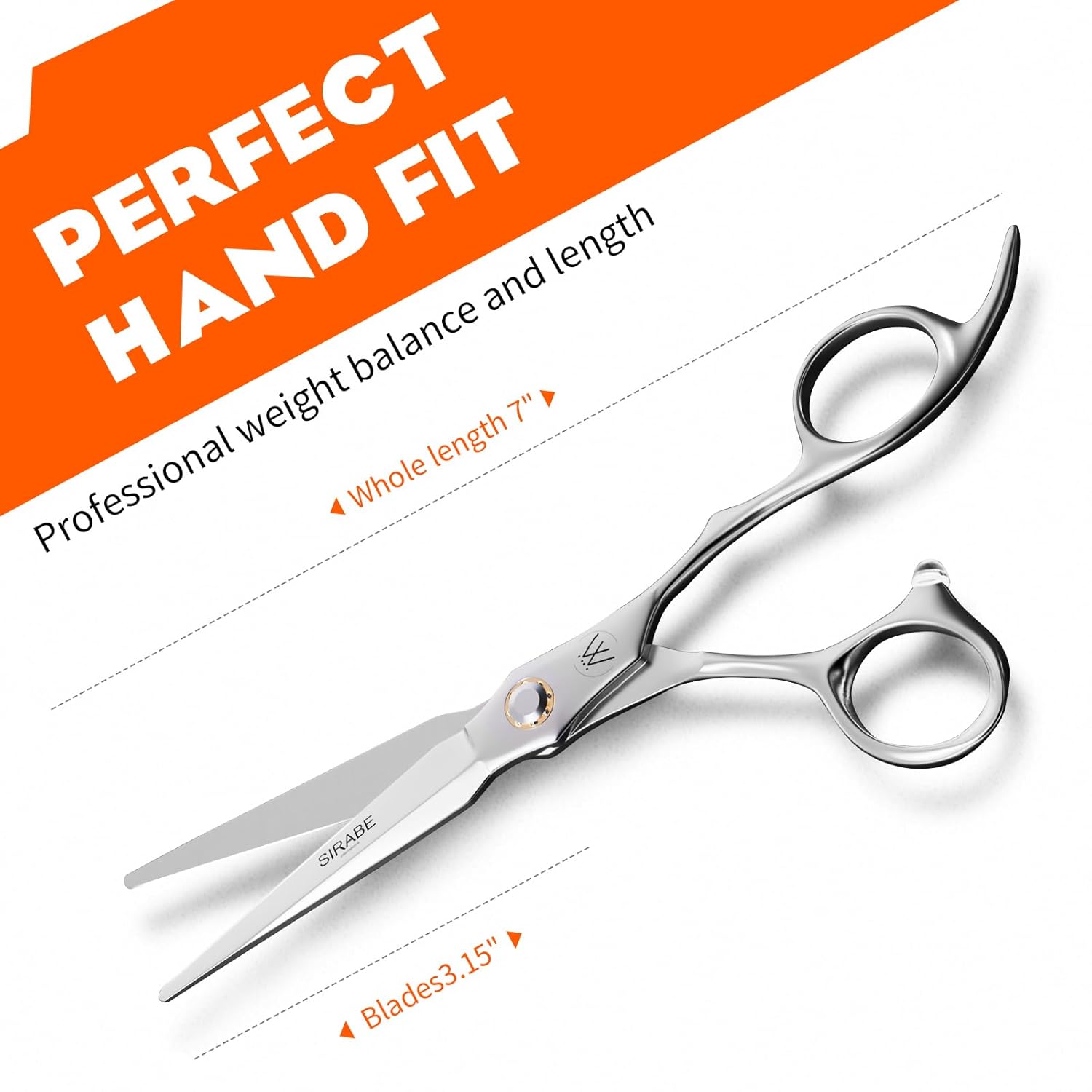
Professional shears — the scissors stylists use for haircuts — are not all made equal, and the difference isn’t just price. The two things that matter most in a quality shear are the steel alloy (what the blade is made from) and the edge grind (how the cutting surface is shaped). If you’ve been behind the chair for six months to two years, you’ve probably outgrown your student-kit shears and started hearing the phrase 440C convex thrown around. Here’s what that means in plain terms: 440C is a specific grade of Japanese stainless steel, known in the industry for holding a sharp edge under daily use. A convex edge grind means the blade’s cutting surface is curved outward — a shape that allows a cleaner, quieter cut through hair than a flat or beveled edge. Together, they’re the combination that defines the “mid-premium” tier of professional shears, typically priced between $150 and $400. This guide is for stylists at the point where that investment is on the table — and who want to know whether it’s actually worth it.
Why 440C and Convex Matter More Once You’re Booking Real Volume
Your student shears got you through your hours. They were probably 420J2 or 420-grade steel — softer alloys that are easier and cheaper to manufacture, but that dull faster under daily service load. Once you’re cutting eight to twelve heads a day as a booth renter or junior stylist, that dullness compounds. A blade that folds hair rather than slicing it cleanly creates micro-friction with every cut, which translates directly into hand and wrist fatigue by mid-afternoon.
Modern Salon’s overview of professional shear materials notes that 440C steel sits at a hardness rating of approximately 58–60 on the Rockwell C scale (HRC) — the standard measure of metal hardness. That’s meaningfully harder than the 52–56 HRC range typical of entry-grade steel. The practical implication: a 440C shear can hold a factory edge roughly two to three times longer between professional sharpenings, per published manufacturer specifications across brands like Hikari, Yasaka, and Kamisori. For a stylist doing heavy blunt-cut work or dry cutting — both of which demand a consistently sharp edge — that retention difference is tangible in your cut quality and in your sharpening costs over a year.
The convex grind compounds the benefit. Behind the Chair’s shear education content explains that a convex edge, sometimes called a “hamaguri” or “clam shell” edge in Japanese blade terminology, creates less surface contact with the hair strand during the cut. The result is what most experienced stylists describe as a “sliding” or “buttery” feel — the shear moves through the section rather than pushing against it. For slide cutting, point cutting, and any technique where you’re working with the shear partially open, a convex edge is close to a requirement. A beveled edge (common on student shears and many under-$100 options) creates drag that makes those techniques harder to control and tiring to repeat.
The $150–$400 Price Ladder: What You’re Actually Paying For
The mid-premium range runs from roughly $150 to $400 for a single shear, and the jumps within that range are meaningful. Here’s how to read the tiers:
$150–$200 (Entry Mid-Premium) Brands in this range — Kamisori, Ichiro, and some Hikari entry models — are using genuine 440C steel with a convex grind, but the fit, finish, and tension systems are simplified. You’ll typically find a basic flat screw tension adjuster. Owners across aggregated reviews on platforms like Amazon and SalonCentric consistently report solid cutting performance for the first year, with more variability in how long the edge holds past the 18-month mark without a touch-up sharpening. These are strong value picks for a stylist building out a first “real” kit on a booth-renter budget.
$200–$300 (Core Mid-Premium) This is the most competitive tier, and where the value-per-service math tends to peak. Brands like Yasaka (Japan-made, widely respected in professional circles), Kamisori Shear’s mid-tier lines, and Joewell’s entry models compete here. American Salon’s shear buying content identifies this range as where consistent Japanese manufacturing tolerances — blade alignment, hand-polished edges, stable tension systems — become reliable rather than hit-or-miss. The key upgrade over the entry tier is typically a click or dial tension adjustment system, which lets you tune the shear’s resistance to your cutting pressure and technique throughout the day. Operators who review these shears long-term frequently note that the edge holds well past 18–24 months of daily use before needing a professional sharpening.
$300–$400 (Upper Mid-Premium / Pre-Luxury) Here you’re approaching the floor of what the industry considers luxury shears ($400–$800+). Brands like Hikari’s professional-series models, Joewell’s GL and GF lines, and Kasho’s design master series sit in this range. Beauty Launch Pad’s shear specification coverage notes that at this tier, manufacturers typically use hand-inspection and selective assembly — meaning blades are matched by hand for alignment rather than assembled to a standardized tolerance. The practical difference that owners report: more consistent cutting feel straight out of the box, and longer edge retention. If your service menu includes dry cutting, razor-like slide techniques, or you’re doing six-plus precision cuts daily, the upper end of this range starts to justify itself on longevity alone.
By the Numbers
| Tier | Typical Price | HRC (Steel Hardness) | Edge Life (Avg. Before Sharpening) | Best For |
|---|---|---|---|---|
| Entry Mid-Premium | $150–$200 | 58–60 HRC | 12–18 months daily use | First upgrade from student kit |
| Core Mid-Premium | $200–$300 | 58–62 HRC | 18–24 months daily use | Booth renters, general service menus |
| Upper Mid-Premium | $300–$400 | 60–63 HRC | 24–30+ months daily use | Heavy volume, precision/dry cut specialists |
Edge life estimates are based on manufacturer-published specifications and aggregated stylist reviews; individual results vary significantly with technique, maintenance, and sharpening quality.
The Tradeoffs No One Talks About in the Product Listing
Convex edges are more expensive to sharpen. This is the most commonly overlooked cost in the 440C convex conversation. A beveled-edge shear can be sharpened on a standard whetstone or by most general sharpening services. A convex edge requires a sharpener with the specific equipment and technique to maintain that curved profile. Professional sharpening for a convex shear runs $25–$65 per shear depending on your market, versus $15–$30 for a standard bevel. Budget this into your cost-per-service math. If you’re sharpening once a year and getting 3,000 cuts out of a shear, that’s less than $0.02 per cut in sharpening cost — negligible. But if you’re sending shears out every six months and paying a premium rate, it’s a real line item.
Japanese vs. German steel is a real choice, not a marketing distinction. The 440C shears discussed here are almost universally Japanese or Japanese-influenced manufacturing. German steel shears (typically from brands like Wusthof’s shear lines or Dovo) use a different alloy profile — harder spine, slightly different edge behavior — and are more common in the European-style barbering tradition. Neither is objectively superior; they suit different hand pressures and techniques. If you trained with a German-style shear and that’s your muscle memory, switching to a Japanese convex grind takes deliberate adjustment. Behind the Chair’s education content addresses this directly: the cutting stroke mechanics differ, and stylists who try to use a Japanese convex shear with the same thumb-driven push they’d use on a German bevel frequently report premature edge damage.
Offset vs. crane handles change your ergonomics more than your cut. The handle shape — whether the thumb ring is aligned with the finger ring (classic) or dropped lower (offset or crane) — affects wrist and elbow angle during cutting. At the mid-premium tier, most manufacturers offer both configurations at the same price point. This is a personal ergonomics decision, not a quality indicator. Stylists with any history of wrist strain or early-stage repetitive stress symptoms should default to a crane offset; the reduced ulnar deviation (the wrist angle required to bring the thumb ring into a neutral cutting position) is well-documented in professional ergonomics guidance.
Gray market is a real risk at this price point. A $280 Yasaka shear has enough margin for a gray-market reseller to undercut authorized dealers by $40–$60 and still turn a profit. The problem is that gray-market shears frequently aren’t covered by the manufacturer’s adjustment warranty, and some are counterfeit entirely — using the brand name with inferior steel. The cost of a sharpening on a counterfeit that was never properly hardened is the shear itself. American Salon’s coverage of the authorized dealer issue notes that the cleaner verification path is to purchase through SalonCentric, established professional beauty distributors, or directly through the brand’s authorized dealer list. When an Amazon listing’s price is significantly below the brand’s published MSRP, that’s your signal to check authorization before purchasing.
The Decision Rule: If X, Then Y
You’ve read the breakdown. Here’s how to land on a number:
If you’re 6–12 months in, cutting 6–10 heads a day, and upgrading from a student kit: The $150–$200 entry mid-premium tier is the right call. You’ll feel the difference immediately in hand fatigue and cut quality, and you’re not over-capitalizing on a shear before you’ve settled into your technique. Brands like Kamisori’s entry professional line represent authorized, widely-reviewed options in this window.
If you’re 12–24 months in, running a full book as a booth renter, and your service menu includes blunt cuts, bobs, or any precision work: Move to the $200–$300 core tier. The Yasaka and Joewell models at this price point are consistently cited by working stylists in Behind the Chair community discussions as the sweet spot of reliability and longevity. The edge retention difference over the entry tier pays back in sharpening cost and consistency within your second year.
If you’re 18+ months in, dry cutting or slide cutting is a meaningful part of your menu, and you’re doing 10+ cuts daily: The $300–$400 upper tier is worth evaluating seriously. The hand-fitted edge and longer retention time make the math work at that volume. If you’re also building a suite or personal brand where your tools are visible to clients, the presentation value of a brand like Hikari professional series or Kasho design master is a real secondary consideration — some stylists factor that in, and it’s not an irrational calculation.
Regardless of tier: Buy from an authorized seller, ask for documentation of the warranty terms before purchase, and build the sharpening cost into your annual tool budget from day one. The shear that stays sharp because you maintained it will always outperform the shear you “saved” on and neglected.