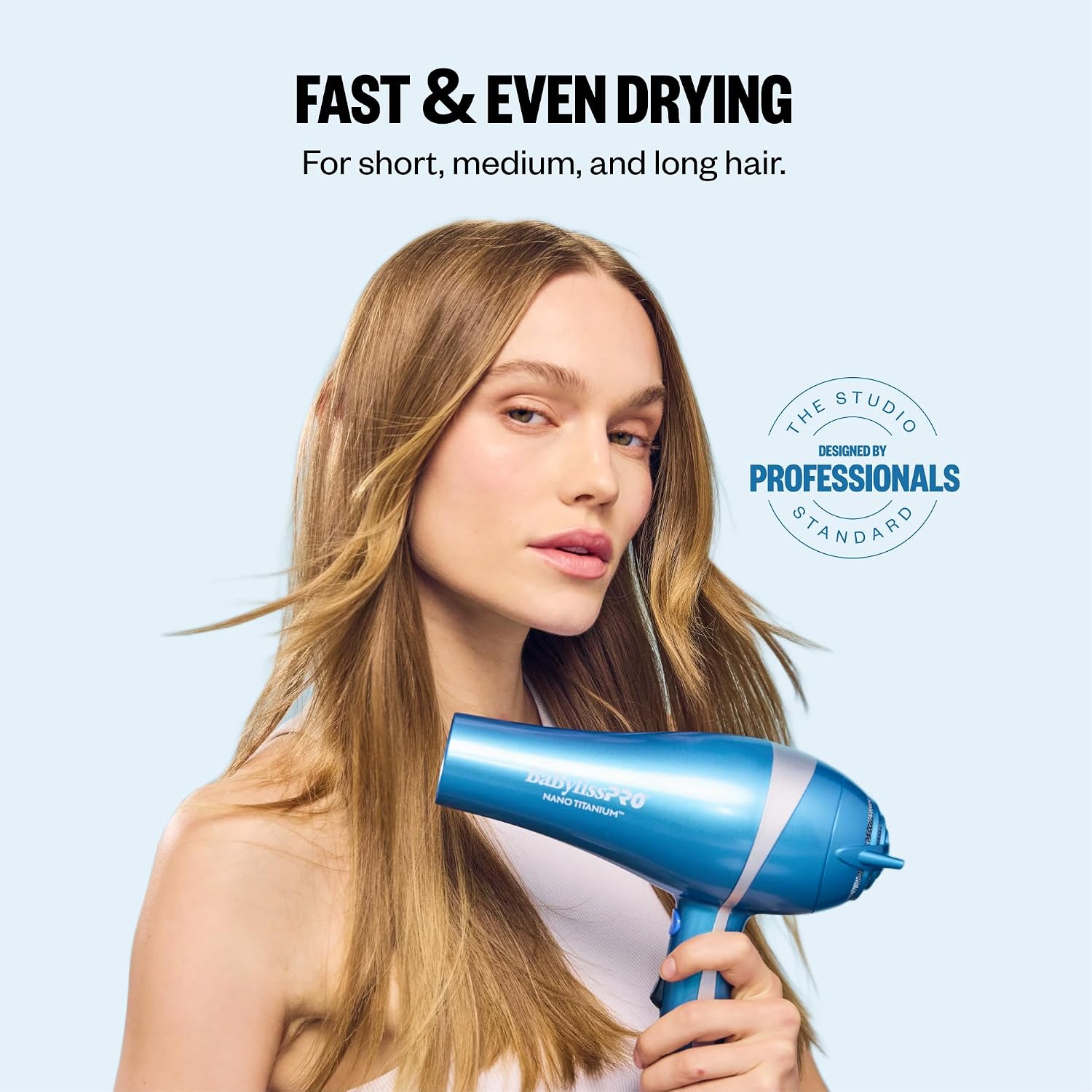
If you’ve ever finished a long Saturday behind the chair with a sore wrist, a ringing ear, or a cord that barely reached your client’s head, you already know that the wattage number on a hair dryer box tells you almost nothing useful. A professional hair dryer is simply a motorized tool that uses heated airflow to dry and style hair — but the spec that matters most at the end of a ten-client day isn’t how powerful it sounds on paper. It’s how the tool fits into your body, your booth, and your service rhythm over thousands of hours of use. This guide skips the marketing buzzwords (ionic, tourmaline, and “salon-grade” are explained below where they actually matter) and focuses on the three physical specs that separate a dryer you’ll love from one that ends up in the back cabinet: weight, noise output, and cord length. You’ll leave with a clear framework for matching those numbers to your real working conditions — and a set of if/then decision rules you can apply to whatever’s currently on your shortlist.
Why “1875 Watts” Tells You Almost Nothing
Every professional dryer on the market — from a $40 student kit dryer to a $500 Japanese motor unit — claims to run at or near 1875 watts, which is the maximum draw allowed on a standard North American 120V/15A outlet. So wattage is a ceiling, not a differentiator. What actually varies is the airflow efficiency at that power draw: how much of those watts get converted into moving air versus heat loss, and how much usable velocity comes out of the nozzle.
This is where motor type enters the picture. AC motors (alternating current) are the traditional workhorse — heavier, louder, longer-lasting under continuous salon use, and typically the choice when a dryer is running 6–8 hours a day. DC motors (direct current) run quieter and lighter but have historically had shorter duty cycles; they’re better suited to lighter daily use or client-facing luxury where noise reduction is a selling point. A third category — brushless DC or high-speed digital motors, as found in the Dyson Supersonic Pro and a growing number of competitors — runs at extremely high RPM with a smaller physical motor, which is why those units are so light despite delivering strong airflow. Wirecutter’s hair dryer testing notes that high-speed digital motors can measure meaningfully faster dry times relative to their physical size, though the premium for that technology is still substantial.
The honest use case framework: if you’re doing 8+ blowouts per day five days a week, a professional AC motor (Parlux, BaBylissPRO Nano Titanium series) earns its weight and price. If you’re doing 3–5 services, a quality brushless DC unit may be the better body-ergonomics trade. The math isn’t about wattage — it’s about motor longevity per dollar and how many grams you’re holding overhead.
The Weight Problem Nobody Talks About Loudly Enough
Here’s the number that should be at the top of every spec sheet but rarely is: dryer weight in grams or ounces, ready to use with nozzle attached.
The Professional Beauty Association’s occupational health literature on salon ergonomics identifies repetitive overhead arm positioning as a primary driver of shoulder and wrist injury among stylists — cumulative trauma disorders that often don’t surface until year 3–7 of a career. Modern Salon has covered the same pattern in multiple features on long-term stylist health, noting that tool weight compounds across a full book in ways that a 5-minute demo at a trade show never reveals.
By the numbers — typical weight ranges by category:
| Category | Weight Range | Representative Models |
|---|---|---|
| Budget/student AC | 680–750 g (24–26 oz) | Generic salon-supply dryers |
| Mid-range professional AC | 560–650 g (20–23 oz) | Parlux 385, BaBylissPRO TT |
| Premium brushless DC | 385–480 g (13–17 oz) | Dyson Supersonic Pro, T3 Cura Luxe |
| Travel/lightweight DC | 300–370 g (10–13 oz) | Not recommended for full daily use |
The difference between a 680g dryer and a 420g dryer feels minimal in your hand for 30 seconds. Across 8 blowouts at 15 minutes each, that’s two hours of overhead and lateral arm movement with a 260g weight differential. Beauty Launch Pad’s tool roundups consistently surface stylist feedback that the transition from a standard AC dryer to a lightweight brushless unit reduced end-of-day arm fatigue noticeably — though that benefit requires evaluating whether the lighter motor will hold up to your service volume over 2–3 years.
Decision rule: If your book runs 6+ blowout-adjacent services per day, weight deserves equal billing with durability in your shortlist criteria. If you’re under 4 services daily, the durability-to-price ratio of a mid-range AC unit likely wins.
Noise: The Spec That Affects Your Client Relationship, Not Just Your Ears
Professional dryer noise is measured in decibels (dB) — a logarithmic scale where 70 dB is roughly normal conversation level and 85 dB starts to represent prolonged-exposure risk. Most professional AC dryers operate in the 78–85 dB range at arm’s length. High-speed brushless motors, despite running at higher RPM, often land in the 68–75 dB range because the motor is smaller and better enclosed — a counterintuitive but well-documented relationship that Wirecutter’s reviews note as one of the clearest measurable advantages of the newer motor technology.
Why does this matter beyond the obvious hearing protection argument? Behind the Chair’s stylist community discussions consistently name the noise level of a dryer as a direct factor in client consultation quality. If you’re doing a service that involves selling an add-on — a gloss, a treatment, a retail recommendation — you need to be able to talk while you’re drying without both of you straining. A 10 dB drop (from 83 to 73) is perceived by the human ear as roughly half as loud. That’s the difference between a client who relaxes and a client who disengages.
What to look for in spec sheets: Manufacturers don’t always publish dB ratings, but reputable brands in the professional segment (Parlux, BaBylissPRO, Dyson, T3) either publish them or have had them independently measured in trade reviews. If a brand can’t or won’t give you a decibel rating, treat that as a yellow flag on their transparency overall.
The ionic and tourmaline question: These terms describe coatings or materials inside the dryer barrel that emit negative ions during operation, which are claimed to reduce static and smooth the cuticle layer of the hair shaft. The functional benefit is real at a basic chemistry level — negative ions help break up water molecules and reduce friction — but the degree of benefit varies widely between products despite identical marketing language. Both terms appear on dryers at every price point. Evaluate them as a potential positive, not as a differentiating promise on their own.
Cord Length: The Operational Spec Everyone Ignores Until They’re Frustrated
A professional dryer cord ranges from about 6 feet (1.8 m) on compact models to 10–12 feet (3–3.6 m) on salon-configured units. That difference changes your entire operational reality.
In a standard booth setup, the outlet is typically at baseboard or counter height behind the station. The average distance from outlet to the top of a client’s head — accounting for chair height, stylist standing position, and working angle — runs roughly 6–8 feet of real-world cord demand. A 6-foot cord with any tension in the line means you’re already at the edge of comfortable reach before you factor in moving around the chair. A 9-foot cord gives you full mobility. A 12-foot cord means no restriction whatsoever, including working around the chair’s front and sides during finishing.
The complications: longer cords add weight (negligible, but real), can create floor hazard in a busy space, and aren’t always compatible with cord retractor mounts. Swivel cord attachments — where the cord connects to the dryer handle via a rotating joint — are a separate ergonomic feature worth checking independently from cord length. A 9-foot cord without a swivel can still torque your wrist on lateral movement; a 7-foot swivel cord can feel more comfortable than a stiff 9-footer.
If you’re in a suite or booth where your outlet position is fixed and inconvenient, cord length is a non-negotiable spec. If you have the luxury of a mounted cord retractor or a flexible outlet layout, you have more flexibility to prioritize other specs first.
Putting It Together: The If/Then Decision Framework
You’ve got a current shortlist. Here’s how to run it through the real filter:
If your service volume is 6+ blowouts per day → prioritize AC motor durability over weight. Look at Parlux 385 Power Light or BaBylissPRO Nano Titanium Volare in the mid-$100s range. Accept 580–650g in exchange for a motor rated for continuous professional use. Factor in a 2-year replacement cycle in your cost-per-service math rather than assuming longevity.
If your volume is 3–5 services daily and client experience is a differentiator → the brushless DC/digital tier earns its premium. The Dyson Supersonic Pro (currently retailing in the $430–$500 range from authorized sellers) and the T3 Cura Luxe represent the clearest noise and weight advantages. Owners in aggregated long-term reviews consistently report 3+ year lifespans under moderate professional use. At that durability, the cost-per-service gap with mid-range AC units narrows substantially.
If you’re equipping a student kit or first booth on a tight budget → don’t buy the cheapest dryer. The sub-$60 tier consistently draws short-lifespan complaints in Beauty Launch Pad and Behind the Chair reviews. The $90–$130 mid-AC tier (BaBylissPRO TT, older Parlux models) represents the honest entry point for durability that survives a full student kit’s lifespan.
If cord length or noise is a constraint due to your specific booth layout → let those specs lead. No amount of motor quality compensates for a cord that doesn’t reach or a noise level that makes your consultation impossible. Check the spec sheet for both before anything else, and verify cord length with the listed measurement including any angled plug housing, which adds 2–4 inches of effective length loss.
One last thing: verify your seller. The professional dryer category has a documented gray-market problem — units sold through unauthorized channels that lack manufacturer warranty coverage. Per the Professional Beauty Association’s guidance on authorized purchasing, buying through SalonCentric, CosmoProf, or a brand’s direct authorized dealer channel is the clearest way to protect a $300–$500 tool investment. Authorized sellers for each brand are listed on the manufacturer’s website; when in doubt, check before you buy.
The marketing copy on a dryer box is written to create desire. The spec sheet — weight, dB, cord length, motor type, warranty terms — is written to tell you what you’re actually getting. Read the second one first.